Robert Szeleney@robert.szeleney
Zum ersten Mal in Cannes – mit wetterbedingtem Zwischenstopp in ParmaFirst time in Cannes with weather-forced stop in Parma
Distanz
950 NM
Flugzeit
7h 31m
Max. Höhe
12 992 ft
Flugzeug
OE-DSZ
💶
Bezahlt
€ 579,00
👥
PAX
2 Personen
🅿️
Parken
3 Nächte
Preise
- Landung, Handling ParmaLanding, Handling Parma
- € 80,00
- Landung, Handling CannesLanding, Handling Cannes
- € 49,00
- Parken Cannes, Azur Premium HangarParking Cannes, Azur Premium Hanger
- € 210,00
- Treibstoff (98l JET A1)Fuel (98l JET A1)
- € 190,00
- Tankwagen-BestellungFuel-Truck Order
- € 50,00
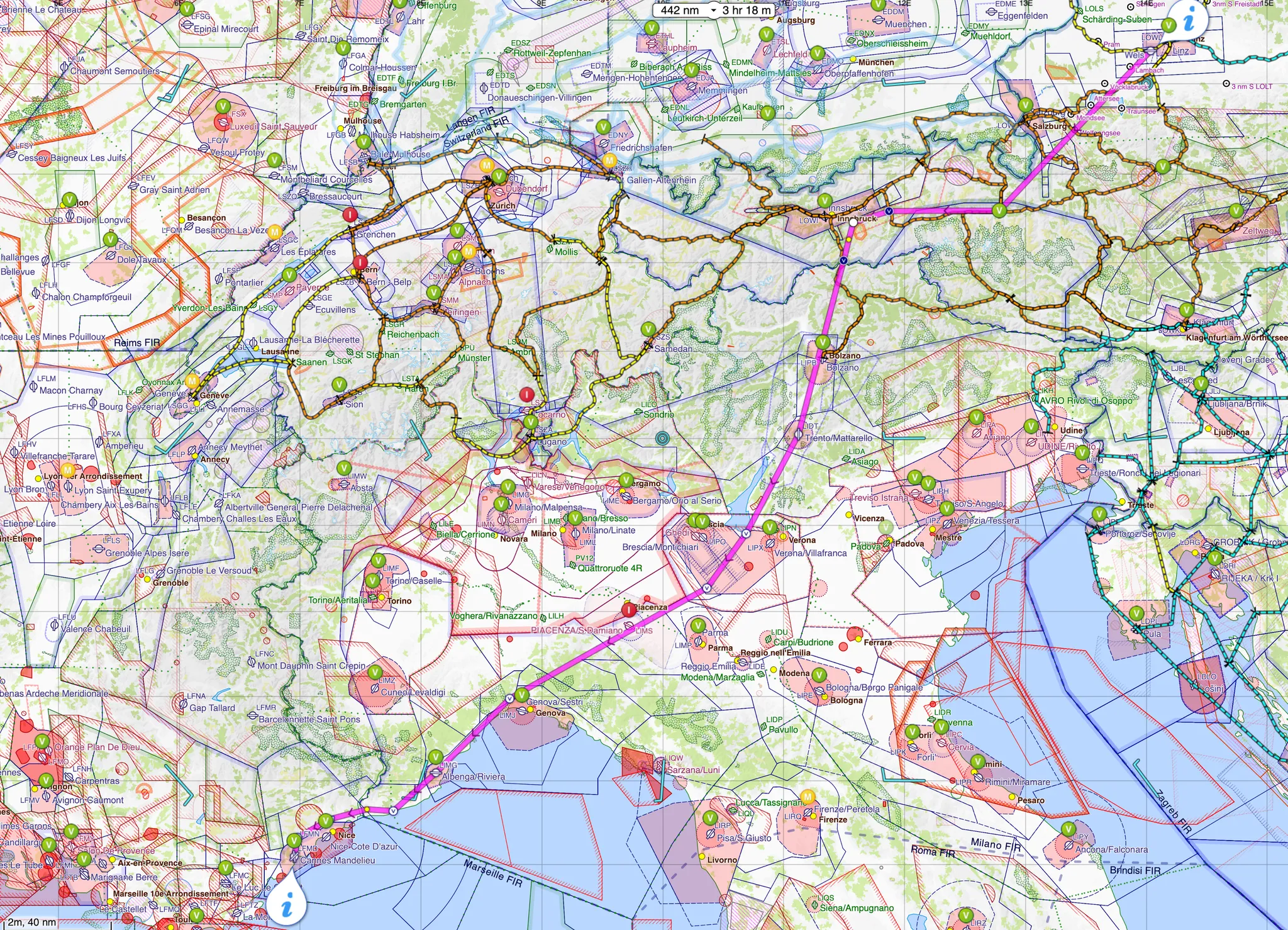
Ein kurzfristig geplanter Flug von LOLW (Wels) nach LFMD (Cannes) mit einem wetterbedingten, einstündigen Sicherheitsstopp in LIMP (Parma).
Motivation für den Trip
Nachdem wir Deutschland, Italien und Slowenien schon besucht hatten, war es höchste Zeit für ein neues Land: Frankreich. Einer der interessantesten und für mich persönlich nächstgelegenen Flugplätze in Frankreich war LFMD (Cannes). Ursprünglich war der Trip für etwa drei bis vier Wochen später geplant, aber dann bot sich früher ein schönes Wochenende an, also fand die Reise früher und eher spontan statt.Die Planung
Mit der Planung haben wir erst einen Tag vor dem Abflug begonnen, mit einer Abflugzeit irgendwann am Nachmittag – in Österreich immer eine Herausforderung, wenn man die Alpen überqueren will. An heißen, sonnigen Tagen können sich in den Alpen recht schnell schlechtes Wetter und Gewitter entwickeln, meist beginnend mit hoch aufquellenden Wolken gegen Mittag. Wir wussten, dass das Wetter nicht toll werden würde, da eine ordentliche Wetterfront von Westen her im Anmarsch war, aber wenn wir vor 15 Uhr starteten, sollten wir zumindest durch die Alpen einen schönen Korridor haben.LOLW (Wels) - LIMP (Parma)
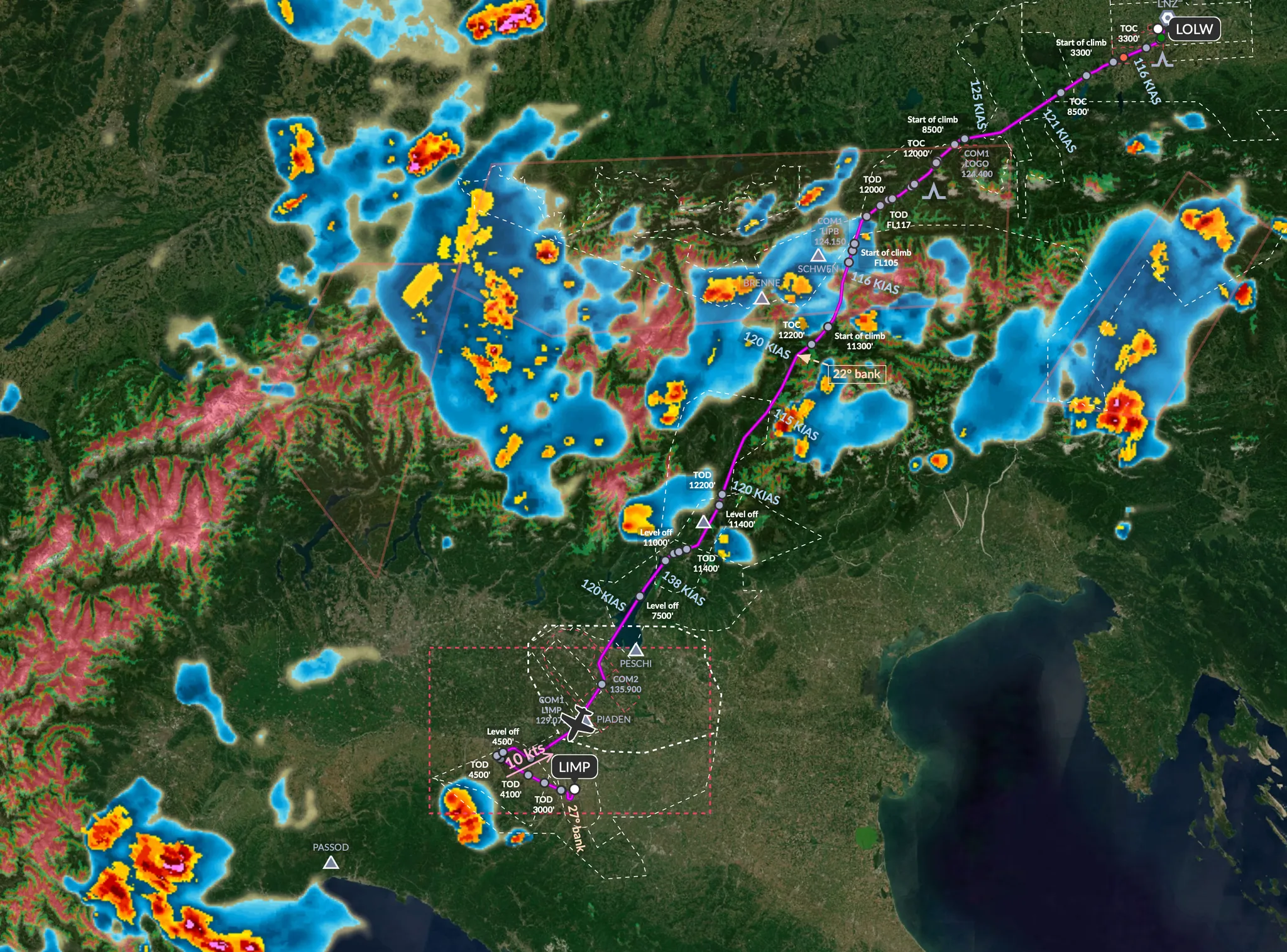
Kurz nach dem Einflug in die Alpen begannen die Wolken aufzuquellen, und in der Umgebung waren diverse Gewitter und Regen zu sehen. Da unsere Route bereits auf diese Wetterlage ausgelegt war, konnten wir zwischen diesen Hotspots weiterfliegen und hatten immer mindestens zwei Ausweichrouten: entweder eine 180°-Umkehrkurve zurück oder nach Osten ausweichen (das Wetter kam nur von Westen). Schließlich hatten wir die Alpen hinter uns und das Wetter wurde schöner – allerdings nur bis in die Nähe von Parma. Schnell entwickelte sich direkt vor unserer geplanten Route eine neue Gewitterzelle, und noch schlimmer: Über der gesamten Côte d’Azur begann sich eine viel größere Zelle zu bilden. Da der Luftraum zu dem Zeitpunkt, als wir diese Wetterlage erkannten, ziemlich kompliziert und eng war (Luftraum Alpha – wir bekamen keine Freigabe zum Einflug), entschieden wir uns für eine Sicherheitslandung am nächstgelegenen Flugplatz, in diesem Fall LIMP (Parma). Nach einem kurzen Gespräch zwischen Markus und ATC bekamen wir die Landefreigabe (wir haben unseren Flugplan direkt mit LIMP umgeleitet) und durften dort auch bis zum nächsten Morgen parken (zum Glück waren noch Abstellplätze frei). Wir mussten entscheiden, ob wir das Flugzeug verzurren – haben wir nicht, da wir (zu Recht) davon ausgingen, dass am Platz nicht viel Wind aufkommen würde. Nach etwa 90 Minuten und einem guten Espresso entschieden wir, dass es sicher sein sollte weiterzufliegen – das Wetter um Parma hatte sich nicht wirklich entwickelt, und wir rechneten damit, dass sich das Wetter an der Côte d’Azur bis zu unserer Ankunft an der Küste schon ausreichend beruhigt haben würde.LIMP (Parma) - LFMD (Cannes)
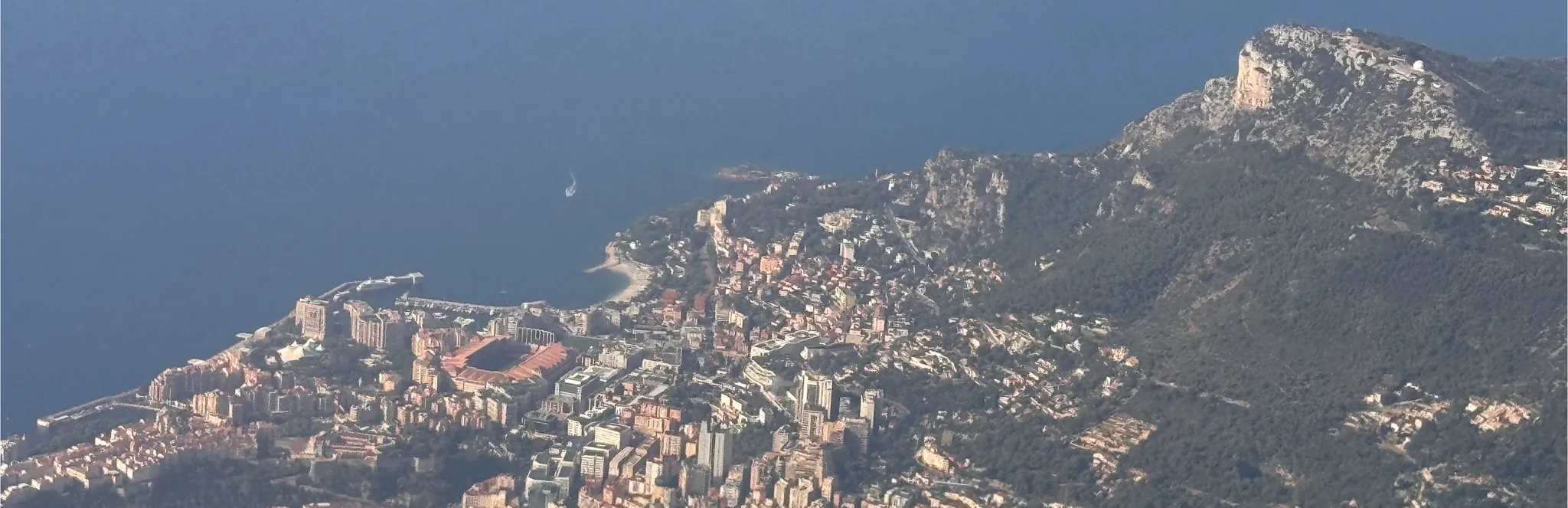
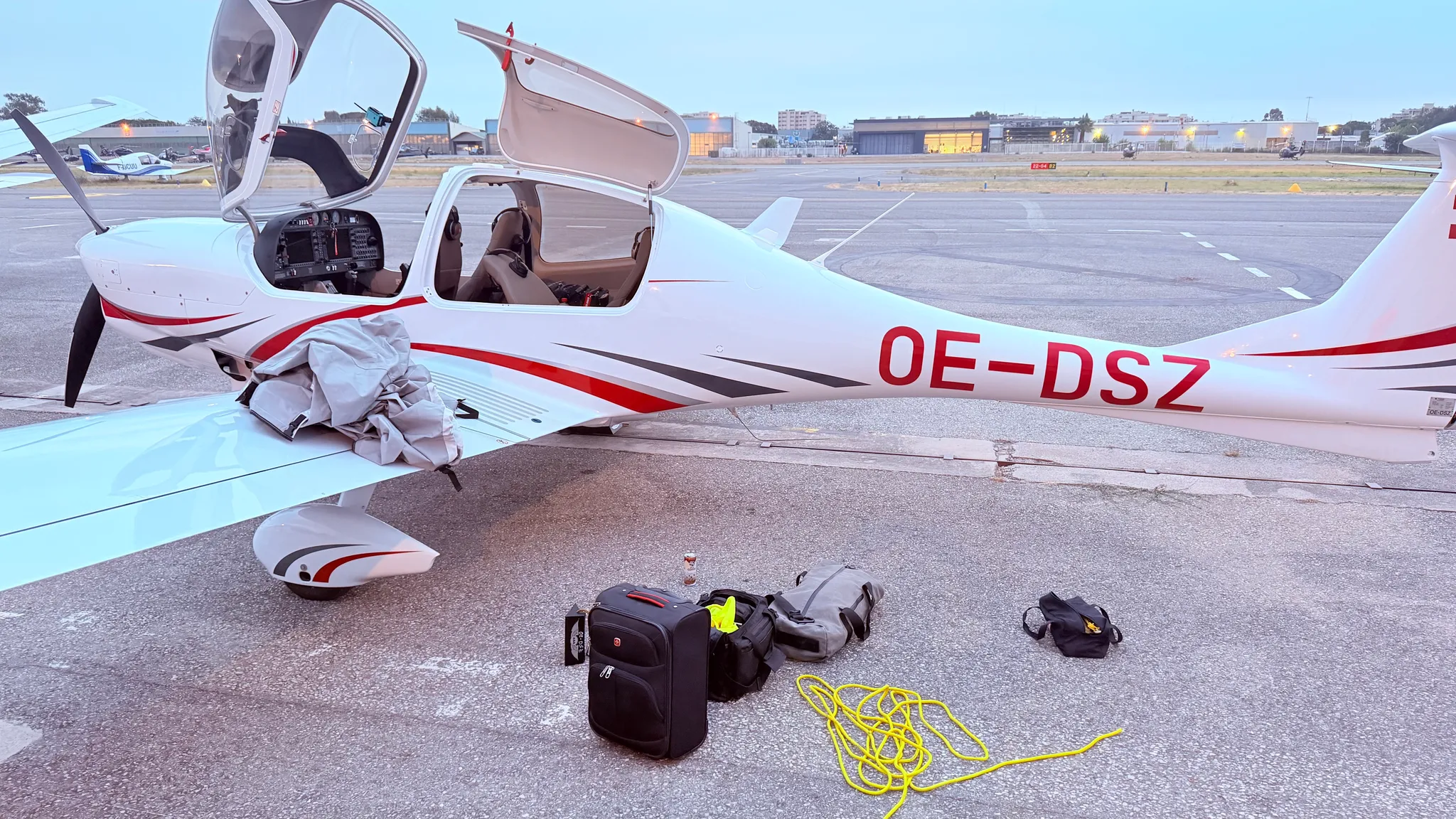
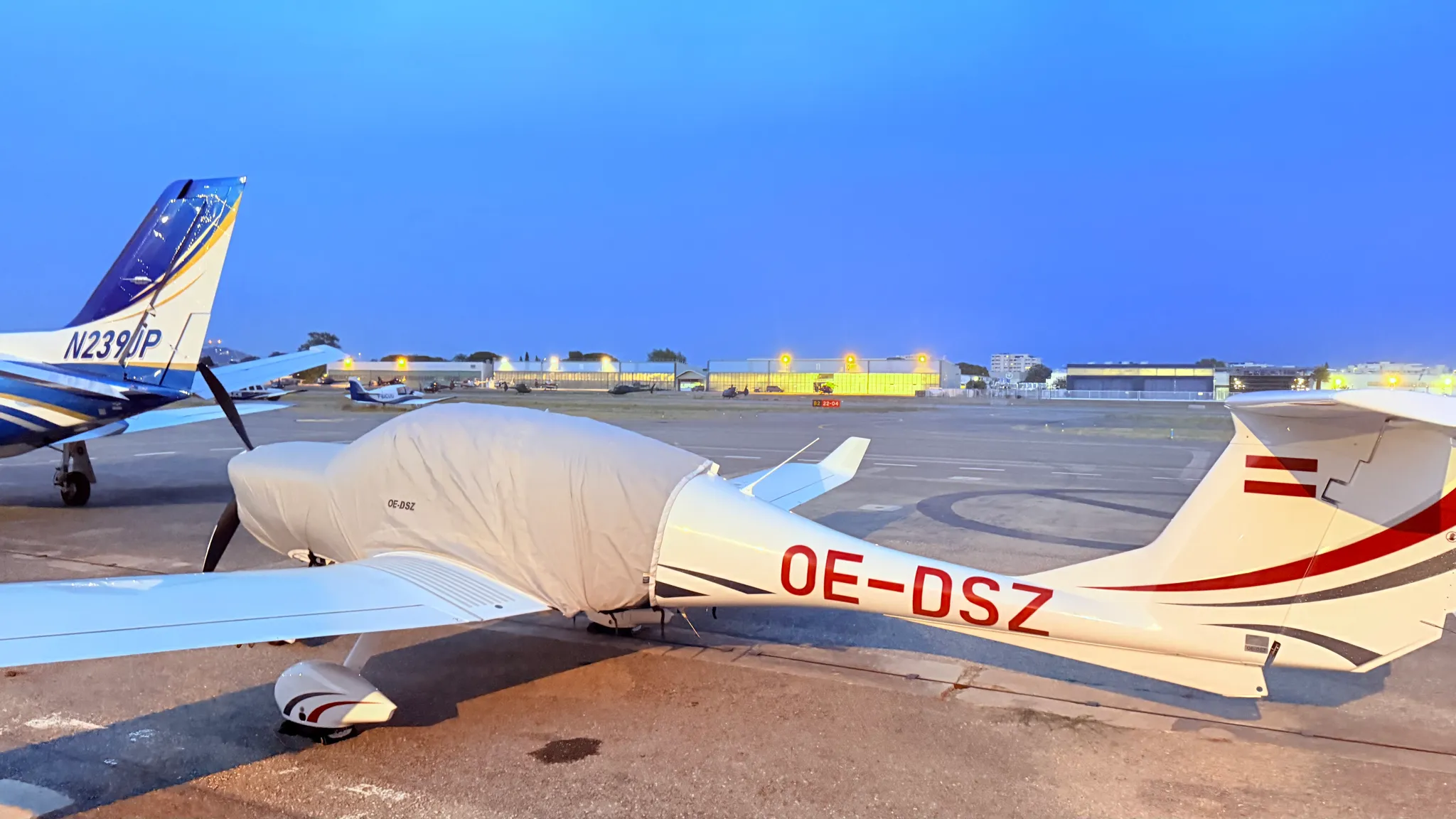
Kurz nach dem Start in LIMP erreichten wir die Überreste des Gewitters über Genua; unter der Wolkenuntergrenze zu fliegen war absolut sicher. Überraschend – und etwas, das wir auf diesem Flug gelernt haben: Wenn man die Schlechtwetterfront „verlässt“, gerieten wir direkt dahinter für etwa 10 Minuten in mäßige Turbulenzen. Danach war der Flug völlig ruhig. Nach Überfliegen der französischen Grenze wechselten wir auf Nice Information, und von dort an wurden wir bis zum Meldepunkt EW für einen langen Endanflug auf Piste 17 „kontrolliert“. Noch eine Erkenntnis: Wenn ihr nach dem Verlassen der Piste die Anweisung „hold short“ bekommt, haltet wirklich ERST NACH dem Rollhalt. Wenn ihr davor anhaltet, hört ihr „You are still on the Runway!!“ Da wir das FBO in Cannes weder per Mail noch telefonisch erreichen konnten, um zu klären, ob ein Hangarplatz frei ist, haben wir „Azur Premium Hangars“ wegen eines Hangarplatzes kontaktiert. Sie antworteten innerhalb von 10 Minuten und boten uns einen Platz auf ihrer Außenfläche an, da ihr Hangar schon voll war. Da wir vom FBO in Cannes überhaupt keine Antwort bekamen, nahmen wir das Angebot dankend an. Wir haben die DA40NG zum allerersten Mal verzurrt – dank der YouTube-Lektionen, die Markus sich angeschaut hatte, war das für ihn ein Kinderspiel 😊 Apropos Azur Premium Parking: sehr empfehlenswert, vom Flugzeug zum Taxi sind es etwa 20 Meter, und sie bieten sogar Wartung, Öl, Flüssigkeiten, Reinigung usw.LFMD (Cannes) - LOLW (Wels)
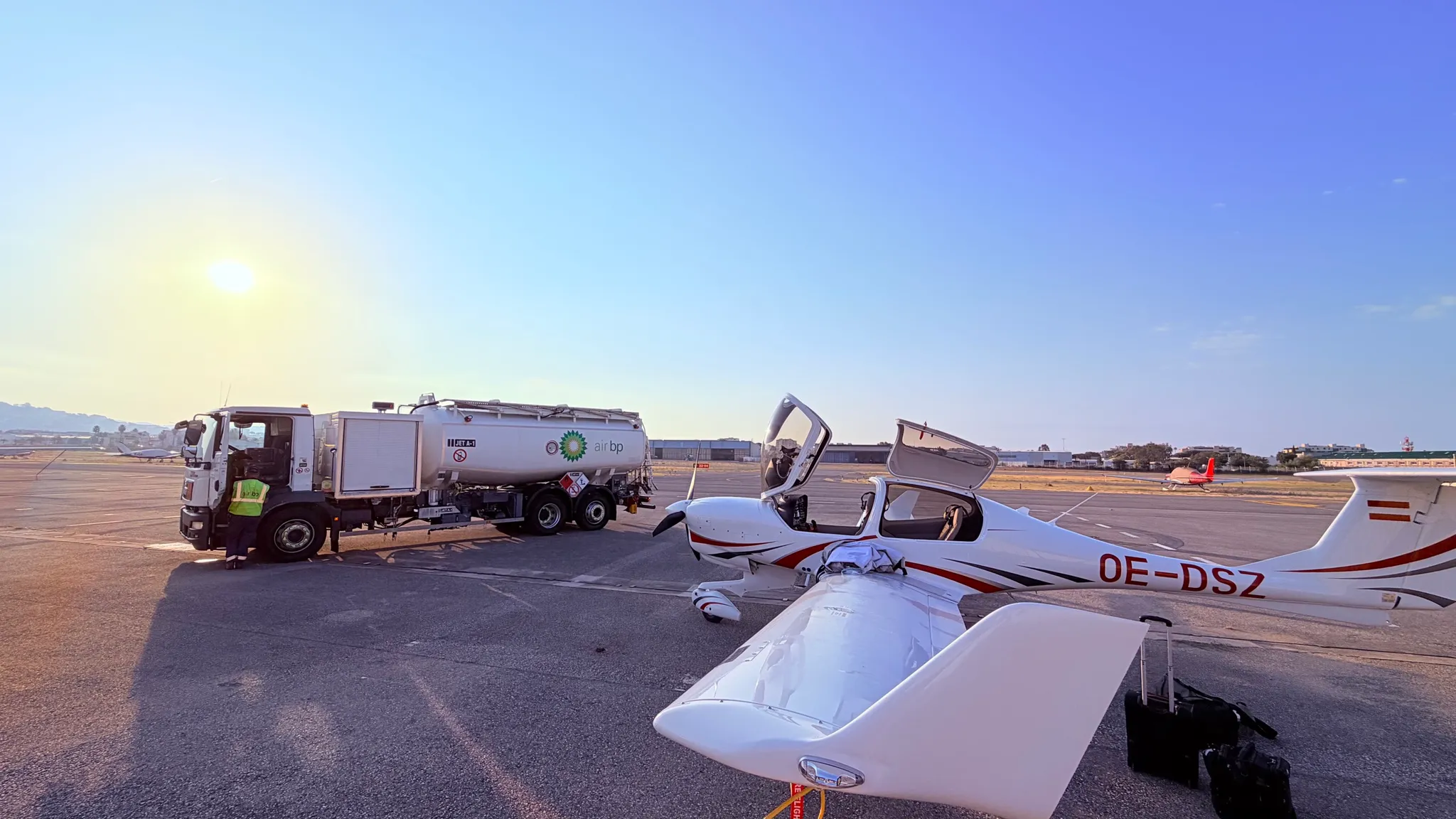
Der Rückflug war ziemlich entspannt. Wir waren früh (07:30) am Flugplatz, haben die Landegebühren beim FBO bezahlt und den Tankwagen bestellt. Während wir das Flugzeug vorbereiteten, war der Tankwagen schon da, und wir tankten 98 Liter. Abflug und Rückroute waren unkompliziert, mit den üblichen, gelegentlich nicht ganz so motivierten italienischen FIS-Lotsen. Es ist in Italien manchmal immer noch schwer zu erkennen, ob man nun eine Freigabe zum Durchflug von Luftraum Delta hat oder nicht (Markus kann davon Geschichten erzählen 😊).Wichtigste Punkte und Erkenntnisse
Wenn ihr wisst, dass ihr in „bekanntes Wetter“ fliegt, habt immer Ausweichrouten parat. Mein persönliches Limit sind mindestens zwei Ausweichrouten – eine 180°-Umkehrkurve sollte normalerweise immer möglich sein, und ein Ausweichen um 90° nach links oder rechts sollte eine gut durchdachte Option sein. Wenn ihr eine Sicherheitslandung machen müsst, zögert nicht, Tower/Radar des nächstgelegenen Flugplatzes zu kontaktieren oder den Fluginformationsdienst zu fragen, mit dem ihr verbunden seid – wenn es um Sicherheit geht, sind die meist sehr hilfsbereit. Windy (auf dem iPad) ist echt hilfreich und sehr genau, um mögliche Gewitterzellen während des Flugs zu erkennen. Das iPad Pro (11”) hat eine super Internetverbindung, meistens sogar auf FL100A short-planned flight from LOLW (Wels) to LFMD (Cannes) with a weather-forced 1-hour safety stop at LIMP (Parma).
Trip motivation
After visiting Germany, Italy, and Slovenia already, it was about time to take on a new country: France. One of the most interesting and nearest airports in France for me personally appeared to be LFMD (Cannes). Initially this trip was planned to take place about three to four weeks out, but eventually a nice weekend came up sooner, so the trip happened earlier and rather spontaneously.The planning
Planning for this trip was started just one day prior to departure, with a departure time sometime in the afternoon, which is always a challenge in Austria when you plan to cross the Alps. On hot and sunny days, bad weather and thunderstorms can develop rather quickly in the Alps, usually starting with high-rising clouds around midday. We knew the weather was not going to be great, as quite a weather front was incoming from the west, but if we departed before 3 PM we should have a nice corridor, at least through the Alps.LOLW (Wels) - LIMP (Parma)
Shortly after entering the Alps, the clouds began to rise, and various thunderstorms and rain were visible in the vicinity. As our route was pre-planned with this weather situation already, we were able to continue flying between these hotspots, always having at least two emergency routes available: either turning 180° to return, or breaking out to the east (the weather was coming from the west only). Eventually we passed the Alps and the weather got nicer, but only until reaching the vicinity of Parma. Quickly, a new weather cell developed right in front of our planned route, and worse, a much bigger cell began developing over the entire Côte d’Azur. As the airspace was rather complicated and tight at the time we identified this weather situation (Airspace Alpha — we did not get clearance to enter it), we decided to make a safety landing at the nearest airport, in this case LIMP (Parma). After a quick conversation between Markus and ATC, we were cleared to land at the airport (we diverted our flight plan directly with LIMP) and also got the possibility to park there until the next morning (thankfully they had available parking spaces left). We had to decide whether to tie down the plane, which we did not do as we (correctly) assumed not much wind was coming up at the airport. After approximately 90 minutes and a nice espresso, we decided it should be safe to continue the trip — the weather around Parma hadn’t really developed, and we forecasted that by the time we reached the coast, the weather around Côte d’Azur would have cleared up enough already.LIMP (Parma) - LFMD (Cannes)
Shortly after taking off from LIMP we reached the remnants of the thunderstorm over Genova; it was very safe to fly below the ceiling. Surprisingly, and something we learned from this flight, as you “leave” the bad weather front, right behind it we got into moderate turbulence for approximately 10 minutes. After that, the flight was completely smooth. We changed frequency to Nice Information once we passed the French border, and from there on we were “controlled” all the way to waypoint EW for a long final onto Runway 17. Another takeaway: if you get instructed to hold short after leaving the runway, make sure to actually hold AFTER the holding point. If you hold short before, you will hear “You are still on the Runway!!” As we had not been able to get in contact with the FBO of Cannes by mail or phone to check if a hangar space was available, we decided to contact “Azur Premium Hangars” for the possibility to park inside a hangar. They replied within 10 minutes, offering parking at their outside area as their hangar was already full. As we didn’t get any reply from the Cannes FBO at all, we thankfully accepted their offer. We tied down the DA40NG for the very first time — thanks to the YouTube lessons Markus had watched, it was an easy task for him 😊 Speaking of Azur Premium Parking, highly recommended, from plane to taxi its about 20 meters, they even have maintenance, oil, fluids, cleaning, etcLFMD (Cannes) - LOLW (Wels)
The flight back was a rather easy one. We arrived early (07:30) at the airport, paid our landing fees at the FBO and ordered the fuel truck. While preparing the plane, the fuel truck arrived already, and we refueled 98 liters. Departure and the route back were easy, with the usual occasionally not-so-motivated Italian FIS controllers. It’s still sometimes difficult to identify whether or not you’re cleared to cross Airspace Delta in Italy (Markus can tell stories about this 😊).Key points and takeaways
If you know you’re flying into “known weather,” be sure to always have escape routes. My personal limit is to have at least two escape routes — usually a 180° turn should always be possible, and diverting 90° left or right should be a well-understood option. If you have to make a safety landing, don’t hesitate to contact tower/radar of the nearest airport, or ask the Flight Information Service you are connected to — usually they are very helpful if it’s about safety procedures. Windy (on iPad) is really helpful and very accurate to identify potential weather cells while in flight. The iPad Pro (11”) has superb internet connection, most times even at FL100🌐 Übersetzt aus dem Englischen ·